
Queue Management System in Saudi Arabia: Setup Checklist
Installing a queue management system in Saudi Arabia is less about buying a screen and more about running a smooth project. Skip the planning and you end up with a shiny kiosk that nobody trusts. Follow a proper checklist and you get a lobby that runs itself. This step-by-step guide covers survey, wiring, configuration, and launch, with a look at how the same discipline scales to drive-thru lanes across the region and in Pakistan.
Over several rollouts I have learned that the projects which fail rarely fail on hardware. They fail on unclear service maps and rushed training. So this checklist front-loads the thinking that actually determines success.
Step one: map your services before you buy
Write down every service a customer can request, the average time each takes, and the busiest hours. This single document shapes ticket categories, counter routing, and staffing. Without it, the vendor is guessing and so are you.
- List all service types offered at the branch.
- Note the average handling time for each.
- Record peak days and peak hours from memory or receipts.
Step two: survey the physical space
A site survey confirms where the kiosk, main display, and counter screens go, and how cabling will run. Sight lines matter: if a waiting customer cannot see the main display from a comfortable seat, they will crowd the counter anyway.
What a good survey records
Power points, network drops, ceiling type for mounting, ambient noise for audio calling, and Arabic-English signage placement all belong in the survey notes. Getting these right the first time avoids expensive rework.
Step three: configure ticketing and routing
Now translate the service map into the system. Each ticket category routes to the counters with the right skills. Set fair priority rules so that quick services do not starve behind long ones, and vice versa.
| Phase | Owner | Typical duration |
|---|---|---|
| Service mapping | Branch manager | 2 to 3 days |
| Site survey | Installer | 1 day |
| Configuration | Installer plus manager | 1 to 2 days |
| Staff training | Installer | Half a day |
| Tuning window | Branch team | 2 weeks |
What should staff training cover?
Training is where adoption is won or lost. Counter agents need to know how to call the next ticket, park a ticket, and transfer a customer to another service without confusion. Supervisors need the dashboard basics so they can rebalance staff in real time.
Keep the first session short and hands-on. People learn a calling button in minutes, but they only trust the dashboard once they see it match what is happening on the floor.
Step four: launch with a tuning window
Treat the first two weeks as live tuning, not final judgment. Watch which categories overflow, then split them or add a floating agent. The system exposes reality quickly, so this window is your chance to fix the process behind the queue.
Saudi Arabia’s push toward high-quality government and retail experiences is well documented in the national reform programme, and orderly service flow supports those goals directly. You can read about the wider agenda on the official Saudi Vision 2030 portal.
Scaling the same discipline to drive-thru lanes
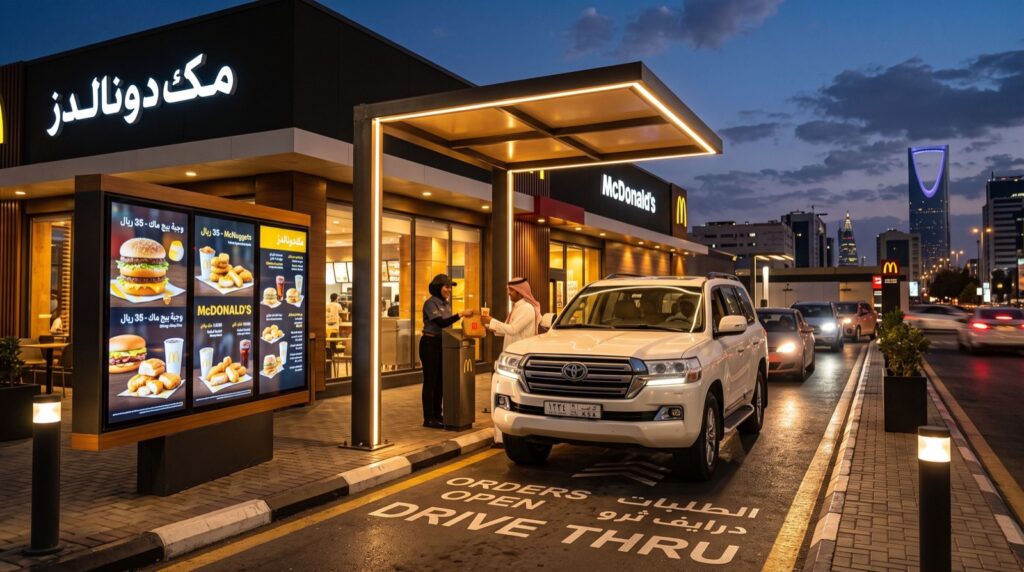
The lobby is only half the story for restaurants and pharmacies. Cars in a lane need the same order-and-serve logic, with headsets, confirmation boards, and lane timers. Businesses expanding into South Asia often ask about a Drive Thru Solution in pakistan that mirrors the reliability they expect from a Gulf deployment.
When lane and lobby share a platform, one supervisor watches both. That is why a well-designed queue management system in saudi arabia is built to extend rather than sit in a silo.
Choosing your installation partner
Hardware brands matter less than the team that fits and supports them. Look for quality service providers who survey properly, configure to your service map, and stay reachable after launch for tweaks and spares.
Post-launch: the numbers to watch
After go-live, track a tight set of metrics weekly. This keeps the project honest and gives you talking points for management reviews.
- Average wait time by service type.
- Average service time per counter.
- Abandonment or walk-away rate.
- Simple satisfaction score after service.
Handling multi-site rollouts
Rolling out to one branch is a project. Rolling out to twenty is a programme, and it needs a template. The winning approach is to perfect a single reference branch, document its configuration, then clone that setup across sites with only local tweaks.
A reference branch gives your team a proven service map, a tested routing scheme, and a training script. Each new location then inherits lessons instead of repeating mistakes, which shortens every rollout after the first.
- Perfect one reference branch before scaling.
- Document configuration so it can be cloned.
- Schedule sites in waves with dedicated training per wave.
- Keep a central dashboard to compare branch performance.
Maintenance and future-proofing
Plan for the boring but vital parts: firmware updates, paper for ticket printers, and periodic dashboard reviews. Agree a support response time in the contract so a broken kiosk never leaves a branch running blind for days.
Future-proofing means choosing a platform that can add mobile ticketing, appointments, and drive-thru lanes when you are ready. You may not switch these on at launch, but having the option protects the investment as your service model grows.
Frequently Asked Questions
How long does a full installation take?
A single branch typically goes from survey to launch inside a week, with a two-week tuning window afterward. Multi-site projects are phased so each location gets its own testing and training.
Do we need to close the branch during installation?
Rarely. Most cabling and configuration happen around business hours, and go-live is usually scheduled for a quieter period so staff can adjust without heavy pressure.
Can the same vendor handle a Pakistan drive-thru rollout?
Established regional providers support both Gulf lobbies and Pakistan drive-thru lanes, applying the same survey-and-configure discipline so quality stays consistent across borders.
What if our peak hours change after launch?
That is exactly what the analytics are for. You revisit staffing and routing whenever the arrival patterns shift, so the system keeps matching reality instead of freezing on day-one assumptions.
Conclusion
A successful queue management system in Saudi Arabia comes from a disciplined project: map services, survey the space, configure carefully, train well, and tune for two weeks. Apply the same rigor to drive-thru lanes at home or in Pakistan and every customer, indoors or in a car, gets a fair, fast experience. Ready to run a clean rollout in 2026? Book a survey with a trusted installer and start with your service map.